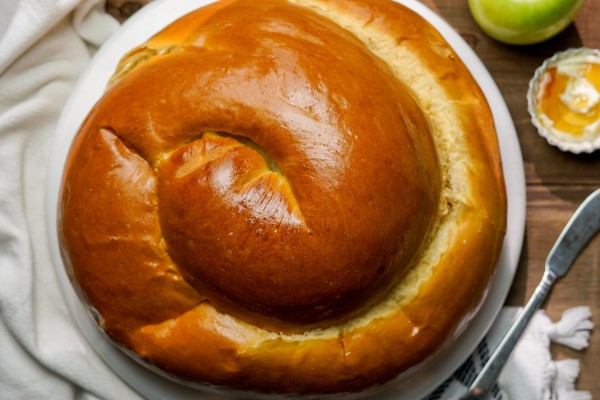
The story behind our Rosh Hashanah challahs
Zingerman’s Bakehouse has been making challah for more than a quarter of a century. Each September we break out these special edition loaves for Rosh Hashanah, the Jewish New Year.
These once-a-year- challahs make any gathering special, regardless of your religion or traditions. Gather round the table, break bread and celebrate all life has brought you and what’s to come. We hope each loaf will bring a deliriously sweet and complete new year to you and yours.
What does round challah represent?
It became traditional among Eastern European Jews to bake challah in round, turban-like loaves. The shape is said to signify the desire for a full, complete year. It’s also made richer and sweeter than plain challah, part of an annual effort by Jewish cooks to bring home a better, sweeter, more fruitful year. Towards that end, bakers add more honey, raisins, additional eggs, and liqueurs – sometimes even saffron. We add a generous portion of extra large Red Flame raisins that we first soak in ultra-rich Myers’ Dark Rum before folding into the dough.
Why is some challah braided?
The Moroccan Jewish community developed another special holiday challah called “Pain Petri.” It’s a beautiful, five-braided loaf whose shape is meant to symbolize the ascent to heaven. Sensually spicy, it’s a rich, egg-based dough sweetened with honey and rolled in magnanimous amounts of anise, poppy, and sesame seeds. To some, the seeds represent the manna that fell from heaven while the Israelites wandered the desert after the Exodus from Egypt.
What to look for in a good varietal honey
Excerpted from Zingerman’s Guide to Good Eating
Flower varietal & geography
Although most people think of honey as a homogenous substance, there are more than three hundred varieties in the world. Every blossom, so to speak, begets its own “brand”, a honey that’s based on the floral source in the same way that wines depend on the grapes they’re made from. The beekeepers set their hives among particular flowers in bloom. Take note, though, that very few honeys actually taste like the flower or the fruit.
Geography plays a big part in the taste of honey as well. The same type of blossom in two different parts of the world will yield honeys of varied texture and flavor. The vintage also makes a difference. Like every other natural food, varietal honey will be different each yet, depending on changing climactic conditions.
Little handling and heat
The less honey is handled after it’s been taken from the hive, the higher the quality is likely to be. Other than a very gentle warming used to loosen and remove honey from the hive, most other heat is likely to be harmful.
No extra flavors
There should be no added fruit flavors, colors, or additives of any sort. Good honey doesn’t need any. Don’t make the mistake of confusing authentic varietal honeys with commercial clover honey that has been flavored. Most of the time Blueberry Honey Creme on a store shelf is made by bees that have never seen a blueberry blossom. It’s nothing more than standard-issue honey with a dose of blueberry extract.
Solid or smooth: both are ok
The majority of good varietal honeys are cloudy and naturally crystallized and thick to almost solid, often completely opaque. In much of Europe, these honeys are the preferred model. Good lavender honey can be creamy white. Honey is primarily made up of relatively equal parts glucose and fructose. The more glucose, the more likely the honey is to be crystalline solid.

All about goat’s milk cheese
Goat’s milk cheeses run the gamut of flavors, but when most of us hear the term one type comes to mind: soft, earthy cheese with a chalky edge and a barnyardy bite. We don’t lump all cow’s milk cheeses into one flavor category. Why are we so cavalier with goats?
Goat’s milk is very fragile compared to cow’s milk.
Flavors reminiscent of a barn likely indicate that the milk wasn’t treated well. As goat’s milk sits, it starts to break up which leads to soapy and rancid flavors that comes through in the final cheese, which is why using fresh milk is important. Goat’s milk also has smaller fats and different acids compared to cow’s milk, so it needs to be processed gently and acidified slowly in order to bring out the desired flavors.
Large commercial producers of goat’s milk cheese are not so gentle. They’re working with large quantities of not-so-fresh milk, pasteurizing it hot and fast, then sealing it up in plastic. All of which lead to unsavory flavors.
You really can taste the difference from small producers.
Zingerman’s goat cheese is made with fresh milk sourced from small Michigan goat farmers. The milk is gently heated and pasteurized at lower temperatures. The milk is then allowed to slowly acidify over a longer period of time to retain those delicate, earthy flavors you want in goat cheese.
Blakesville Creamery relies on the milk of the herd of 1500 goats that live on site at Blakesville Dairy Farm. Less time in transit and more carefully handled cheese results in better tasting cheese.
Another shortcut of industrial producers is to use GMO-modified rennet and veal rennet in their cheesemaking. They’re cheaper, but not made for goat’s milk. Zingerman’s goat cheeses uses rennet specifically created for goat’s milk. Although it’s more expensive, it leads to a better final flavor and supports better aging.
What about aged goat cheese?
Fresh goat cheese highlight the milk’s lovely qualities, fruity sweet flavors and a soft, chalky dryness. As they get older the “goaty” flavors can be accentuated, but well made and well aged goat’s milk cheeses will have more strength and character without any taste of barn. A great example is Brabander – aged six to nine months, the goat gouda cheese turns into a vanilla milkshake of rich flavor.